A packing list looks like the easy document. It has no prices to argue over and no legal wording to get right — you are just writing down what went into the boxes. Then the carrier weighs the container, or a customs officer opens a carton, and the numbers have to line up with everything else in your file. That is where a rushed packing list turns into a held shipment.
So this guide is built around one idea: a packing list is not a standalone form to fill in. It is the document that has to reconcile to your commercial invoice. Get the reconciliation right and the rest of the packing list is just careful transcription.
One scope note before we start. This post does not re-teach the commercial invoice — for the field-by-field breakdown of that document, follow our commercial invoice guide. Here we own the packing list itself and, above all, how its values have to agree with the invoice.
What a packing list is actually for
The commercial invoice answers a money question: what is being sold, to whom, on what terms, and for how much. The packing list answers a physical one: how is that same sale actually packed and moved? It translates the invoice into cartons, pieces, weights, and dimensions so that anyone touching the freight can verify the boxes against the paperwork.
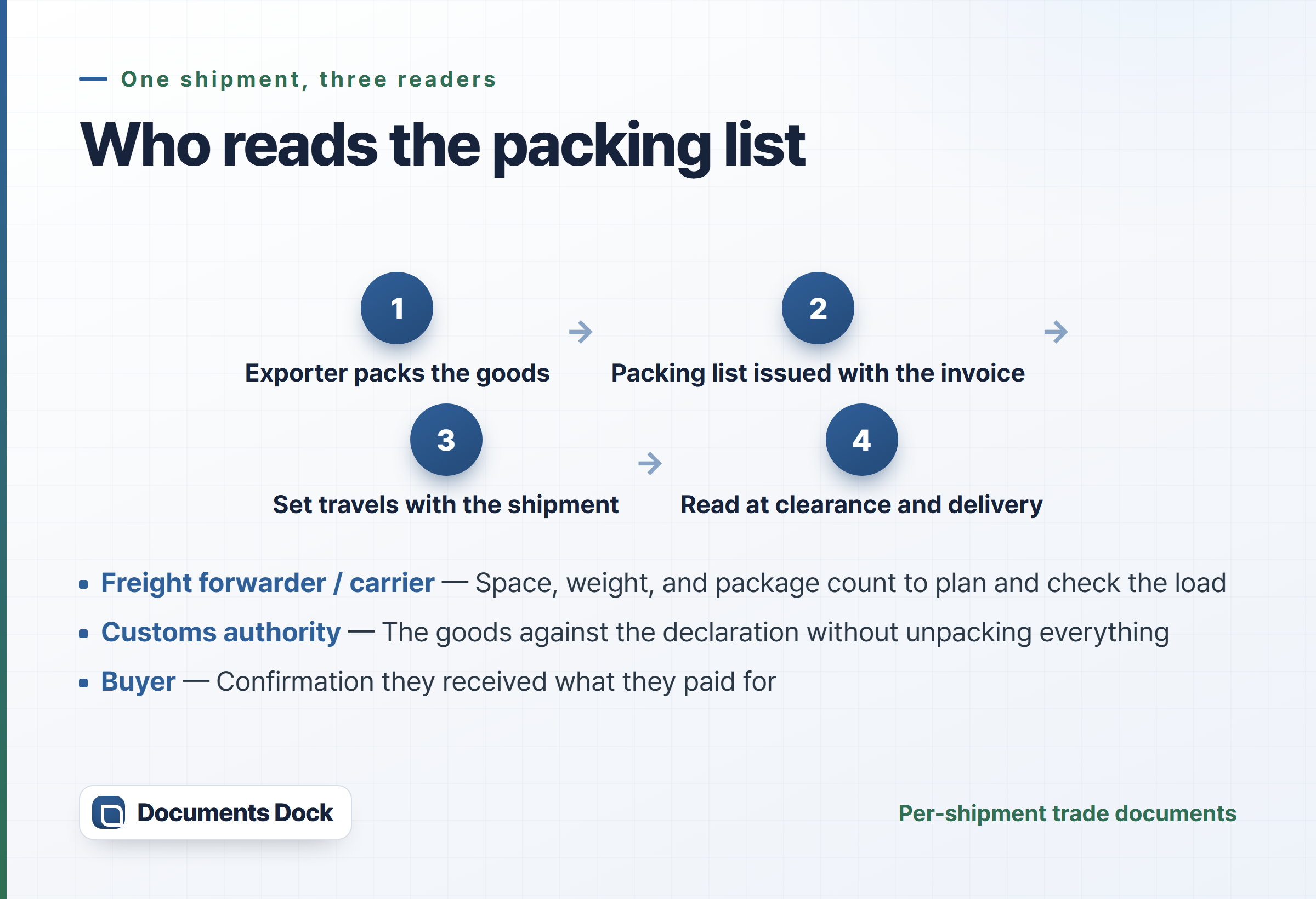
Three parties read it, and each for a different reason. The freight forwarder and carrier use it to plan and check the load — space, weight, and how many packages they are collecting. The customs authority uses it to inspect the goods against the declaration without unpacking everything. The buyer uses it to confirm they received what they paid for. None of them cares about unit price on this document — the packing list deliberately leaves money to the invoice.
Because the packing list and the invoice describe one shipment from two angles, they are only useful together when they agree. A packing list that contradicts the invoice does not add information — it raises a question, and questions at clearance cost days.
What goes on a packing list
There is no single legal format, but customs authorities, forwarders, and buyers expect the same core fields. Think of them in two groups: the header identifies the shipment and ties it to the invoice, and the body describes the packing itself.
- Exporter and buyer details — the same legal names and addresses that appear on the commercial invoice.
- Packing list number and date — a unique reference, ideally cross-referencing the related invoice number.
- Invoice reference — the commercial invoice number this packing list belongs to, so the two are unmistakably one set.
- Goods description — the same wording used on the invoice; do not describe the goods one way here and another way there.
- Quantity and unit of measure — total pieces, and the unit (pieces, sets, pairs, cartons) stated explicitly.
- Package breakdown — number of cartons, pallets, or crates, and how the pieces are distributed across them.
- Net weight and gross weight — the goods alone, and the goods plus packaging, per package and as a total.
- Dimensions and total volume — carton or pallet measurements and the cubic total (CBM), which the carrier uses to plan the load and to rate it (it drives LCL ocean charges and feeds the volumetric/chargeable-weight calculation on air).
- Shipping marks and package numbers — the marks stencilled on the cartons so they can be matched to this list.
- Country of origin and mode notes — where relevant, kept consistent with the invoice and transport booking.
The four values that must reconcile to the commercial invoice
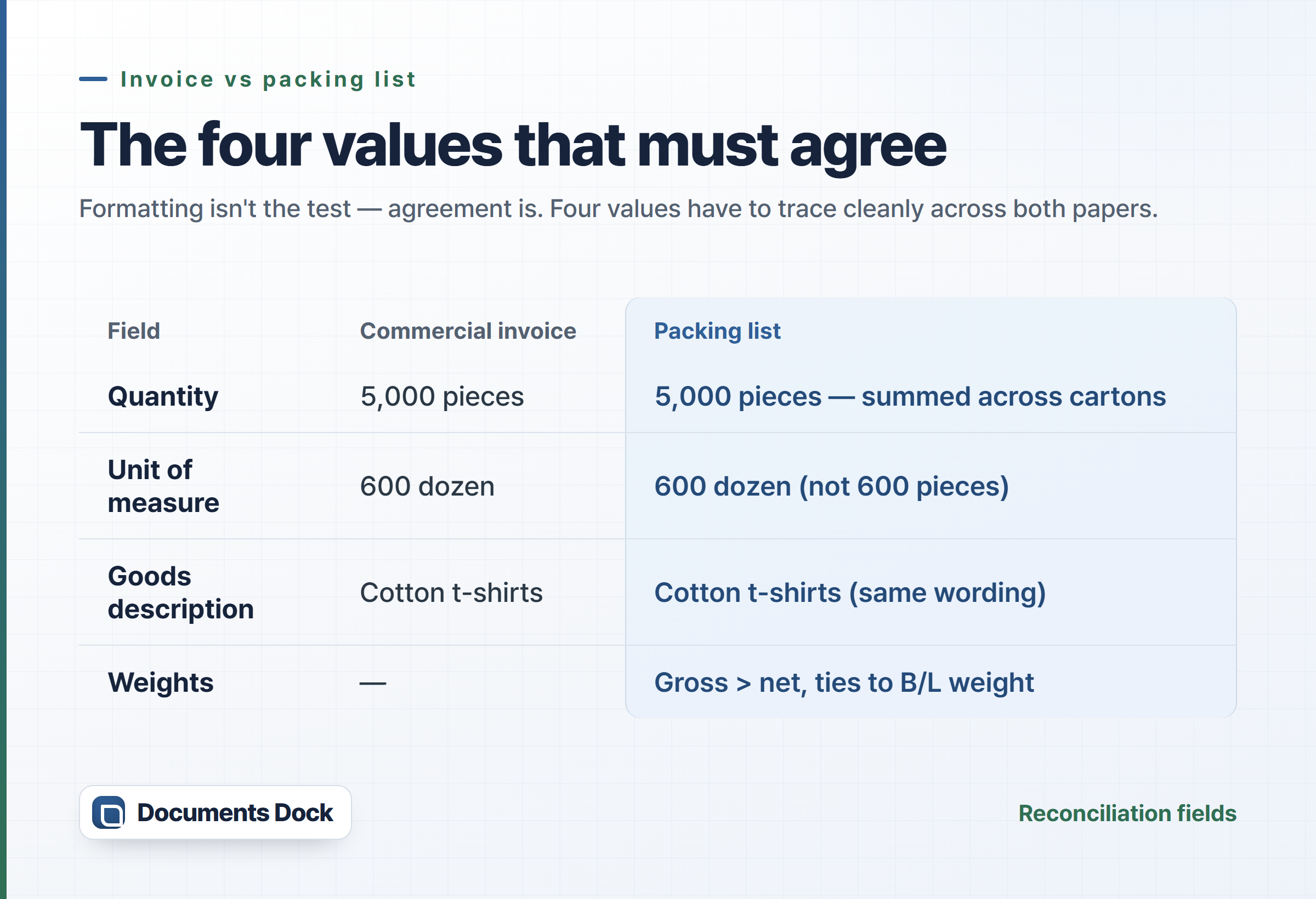
This is the test the whole document has to pass. A packing list can be neatly formatted and still get a shipment held, because formatting is not the test — agreement is. Four values have to trace cleanly from the packing list to the commercial invoice.
Quantity. The total count of goods must be identical on both documents. If the invoice bills 5,000 pieces, the packing list must add up to 5,000 pieces across all cartons — not 4,960 because two boxes were left off.
Unit of measure. This is the one that catches people. '600 dozen' on the invoice and '600 pieces' on the packing list are not the same shipment — a dozen is twelve, so the two papers now describe quantities that differ twelvefold. State the unit explicitly and use the same unit on both documents.
Goods description. The description on the packing list should match the invoice closely enough that a customs officer or bank can see at a glance they refer to the same goods. Divergent wording — 'cotton t-shirts' on one, 'apparel' on the other — invites reclassification and questions.
Weights. Gross and net weight on the packing list must be internally consistent (gross is always greater than net) and reconcilable with the weight the carrier records on the transport document. A net weight on the packing list that cannot be squared with a gross weight of, say, 8,400 kg on the bill of lading is a predictable trigger for a query.
Read the two as one statement
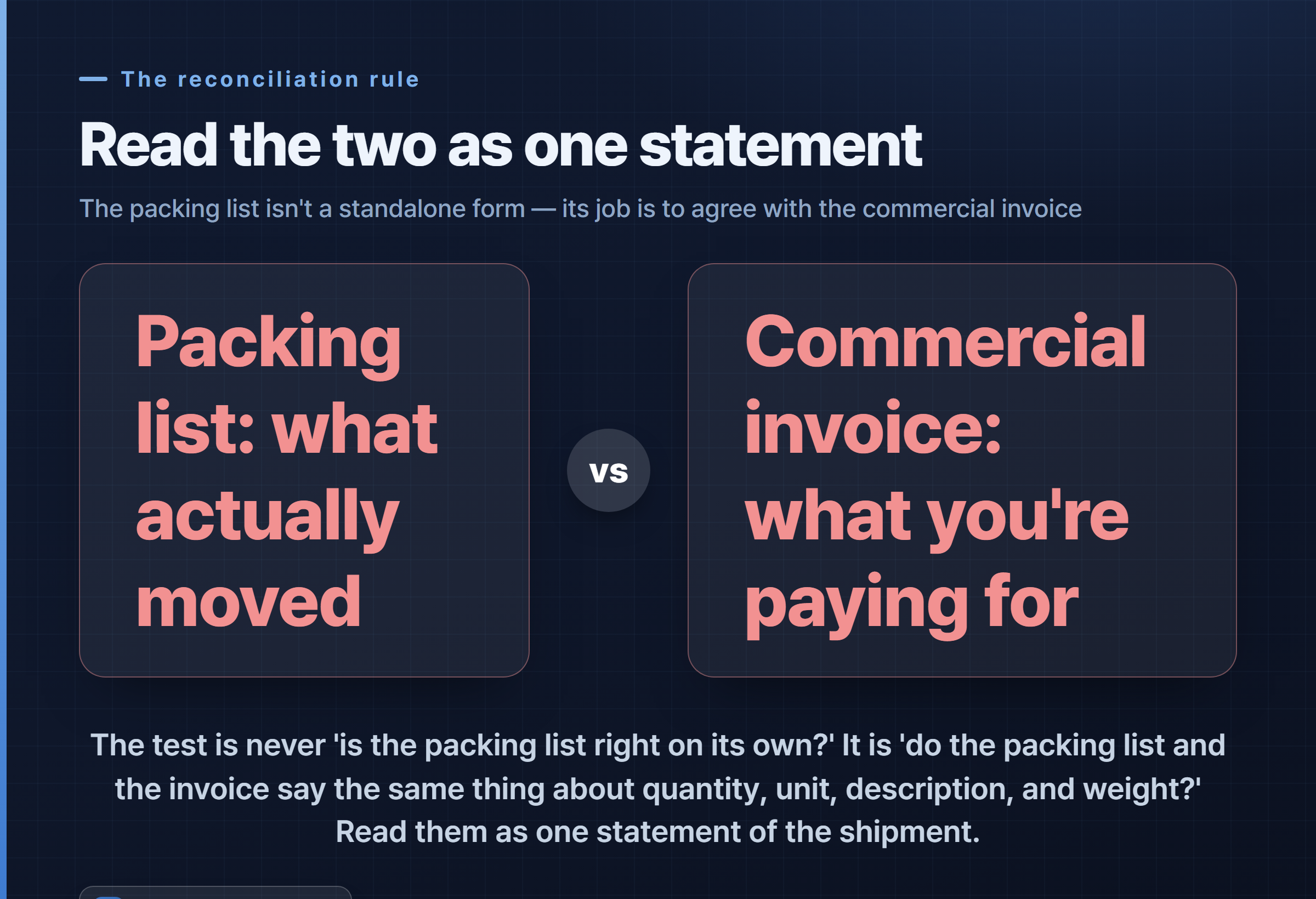
The test is never 'is the packing list right on its own?' It is 'do the packing list and the commercial invoice say the same thing about quantity, unit, description, and weight?' Read them as a single statement of the shipment, one field checked against the other.
Where packing lists and invoices drift apart
The mismatches that hold shipments are rarely exotic. They come from the ordinary ways a packing list is prepared separately from the invoice — a different person, a different spreadsheet, a last-minute repack that never made it back onto the paperwork.
- Unit-of-measure drift — pieces on the invoice, sets or cartons on the packing list, with no conversion stated.
- A late repack — cartons were split or combined to fit the container, but only the packing list was updated, so package counts no longer match.
- Partial shipment — the invoice bills the full order, the packing list reflects what actually loaded, and nobody flagged the short ship.
- Net vs gross confusion — a single weight figure copied into both the net and gross fields, which the carrier's measured weight then contradicts.
- Description shorthand — a generic term used to save time on the packing list that no longer matches the invoice's specific goods description.
- A revised invoice — the price or quantity changed after the packing list was printed, and the packing list was never reissued to match.
Reissue the paper, don't patch the entry
When the packing list and the invoice disagree, fix whichever one is wrong at the source — reissue the packing list yourself (or have whoever prepared it reissue it) to match the final invoice, or correct the invoice. Reconciling only inside the customs entry leaves the mismatch on the papers themselves, and since the two still travel together, it surfaces again.
A packing-list checklist before you ship
Run this before the packing list — and the rest of the set — leaves your desk. It takes a few minutes and removes most of the back-and-forth with your forwarder and customs broker.
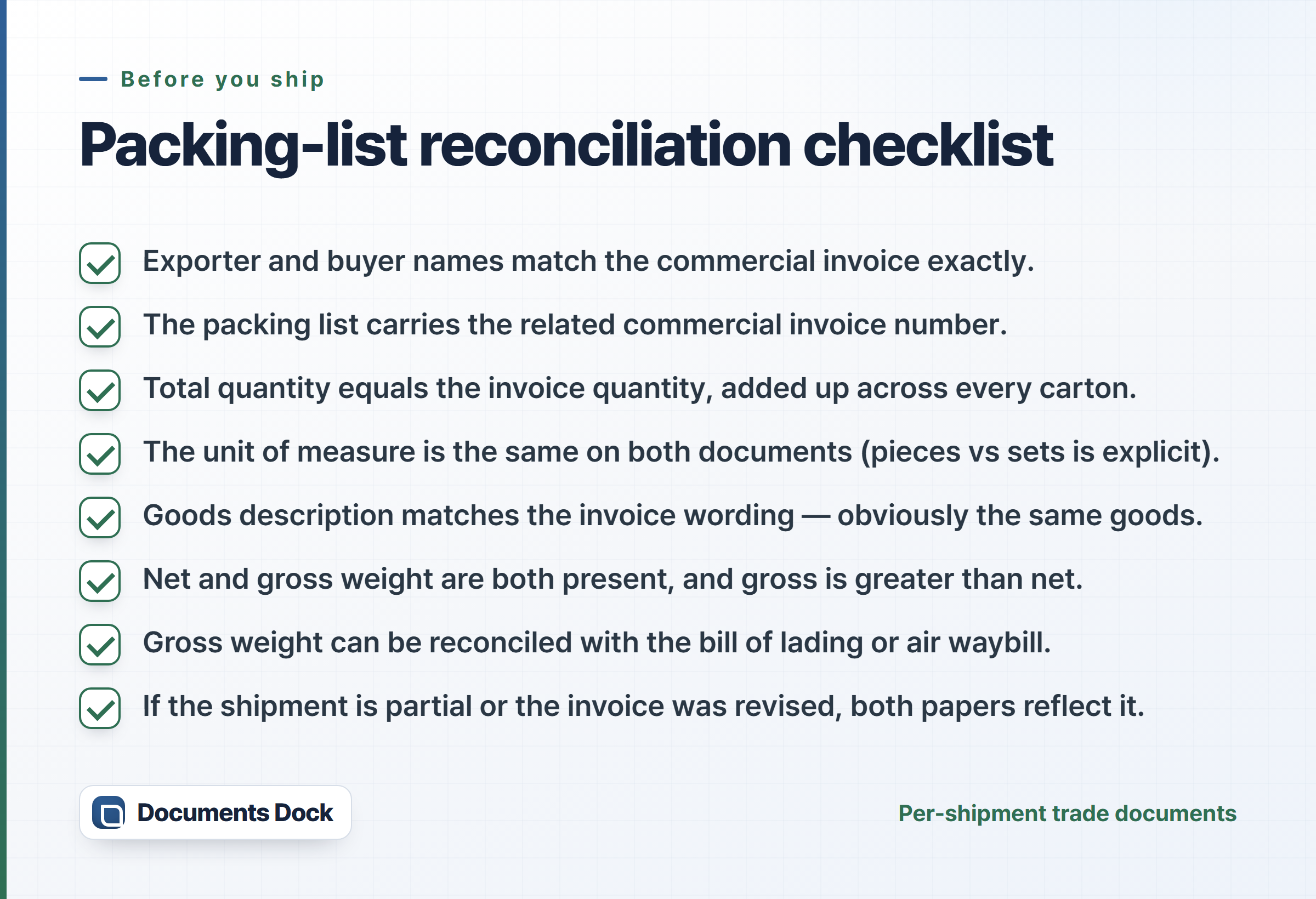
- The exporter and buyer names match the commercial invoice exactly.
- The packing list carries the related commercial invoice number.
- Total quantity equals the invoice quantity — added up across every carton.
- The unit of measure is the same on both documents (pieces vs sets vs cartons is explicit, not assumed).
- The goods description matches the invoice wording closely enough to be obviously the same goods.
- Net weight and gross weight are both present, and gross is greater than net.
- The gross weight can be reconciled with the weight on the bill of lading or air waybill.
- Package counts (cartons, pallets) are consistent with the package breakdown and the shipping marks.
- If the shipment is partial, the packing list and invoice both reflect what actually loaded.
- If the invoice was revised, the packing list was reissued to match the final version.
Reconcile the set before you send it
The packing list is one document in a small set, and the set is only as clean as its agreement. Work the four reconciling values in order: confirm the total quantity matches, then the unit of measure, then the goods description, then the weights — checking each field on the packing list against the same field on the invoice before the set goes out. Reading the two documents together this way catches the disagreements that reading either one on its own never will.
For how the packing list sits in the wider sequence — issued by the exporter when the goods are packed, alongside the invoice, and read by the forwarder, customs, and the buyer — see the full export document set, in order. Getting the packing list to reconcile to the invoice is the single habit that keeps that whole set moving.
Where Documents Dock fits
Documents Dock keeps each shipment's packing list and commercial invoice side by side, so the four values that have to match — quantity, unit, description, and weight — are checked together in one place instead of across two spreadsheets. Line them up per shipment at documentsdock.com.
Sources and scope
This is general information, not a compliance ruling. Exactly which fields and formats a packing list needs depend on your goods, the countries involved, and your terms of sale (Incoterms 2020) — confirm the requirements for your lane with a licensed customs broker or the relevant authority.
- U.S. International Trade Administration (ITA), Common Export Documents (packing list) — trade.gov/common-export-documents
- World Customs Organization, Revised Kyoto Convention — wcoomd.org
- UN/CEFACT, United Nations Layout Key for Trade Documents (Recommendation No. 1) — unece.org/trade/uncefact
- ICC, Incoterms 2020 rules — iccwbo.org/business-solutions/incoterms-rules/incoterms-2020