
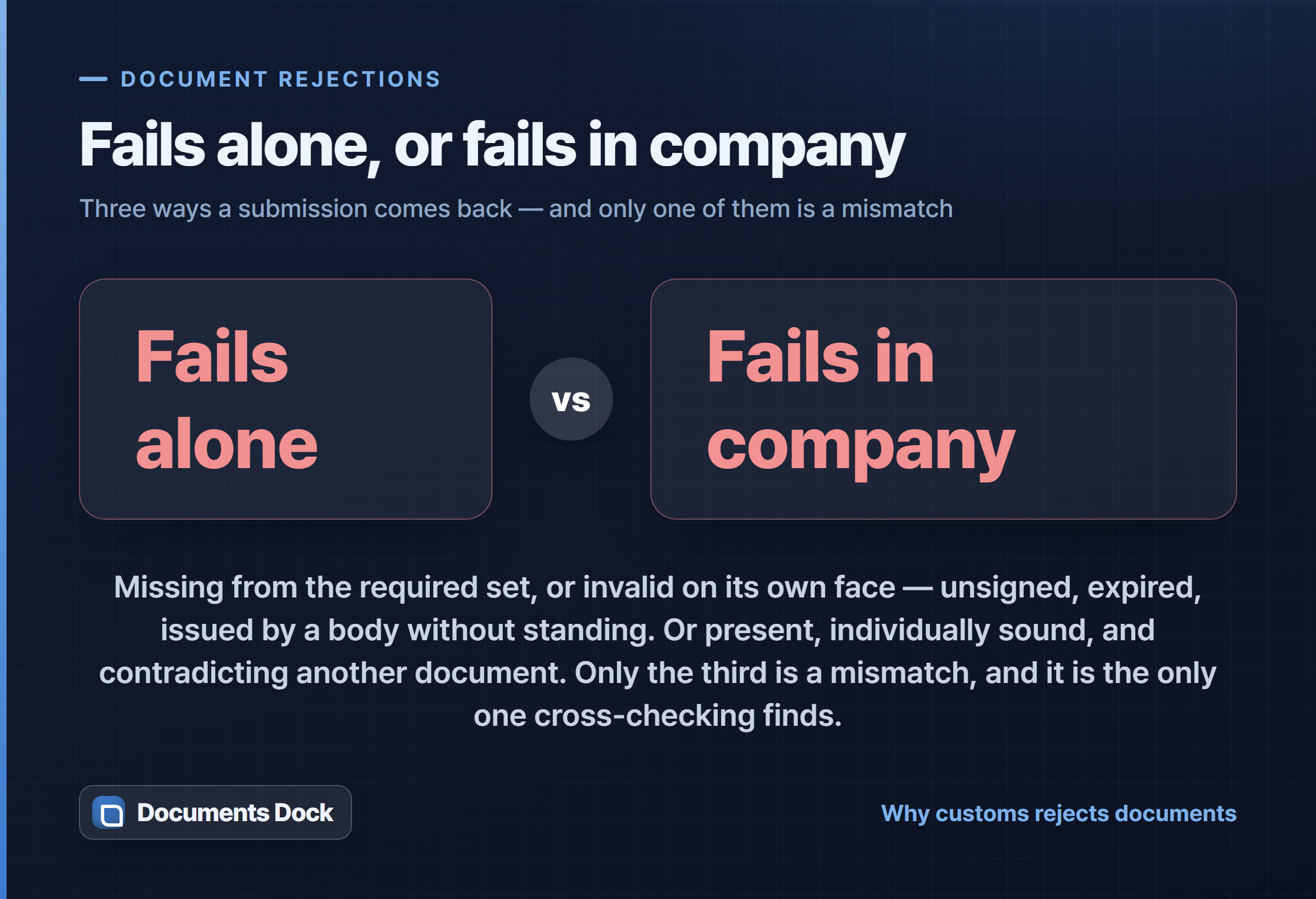
A certificate of origin can agree with every other paper in your set and still be refused, because the wrong body signed it. Cross-checking never finds that one: it is not a disagreement between documents, it is a document that cannot stand up alone.
Customs rejects a document for one of three reasons: it is missing from the required set, it fails on its own face — unsigned, expired, or issued by a body without standing — or it contradicts another document in the same submission. The third kind is what most checking looks for. The first two are what it misses.
If the goods are already stopped, the triage order is in shipment held at customs; this page is the check to run before they move. Missing has no field of its own; the other two kinds do, and eight fields carry them — four fail by disagreement, four fail alone.
What does customs check on your documents?
Customs checks that the declaration is supported: that every document the regime requires is present, that each is valid on its own terms, and that all of them describe the same goods, the same value and the same parties.
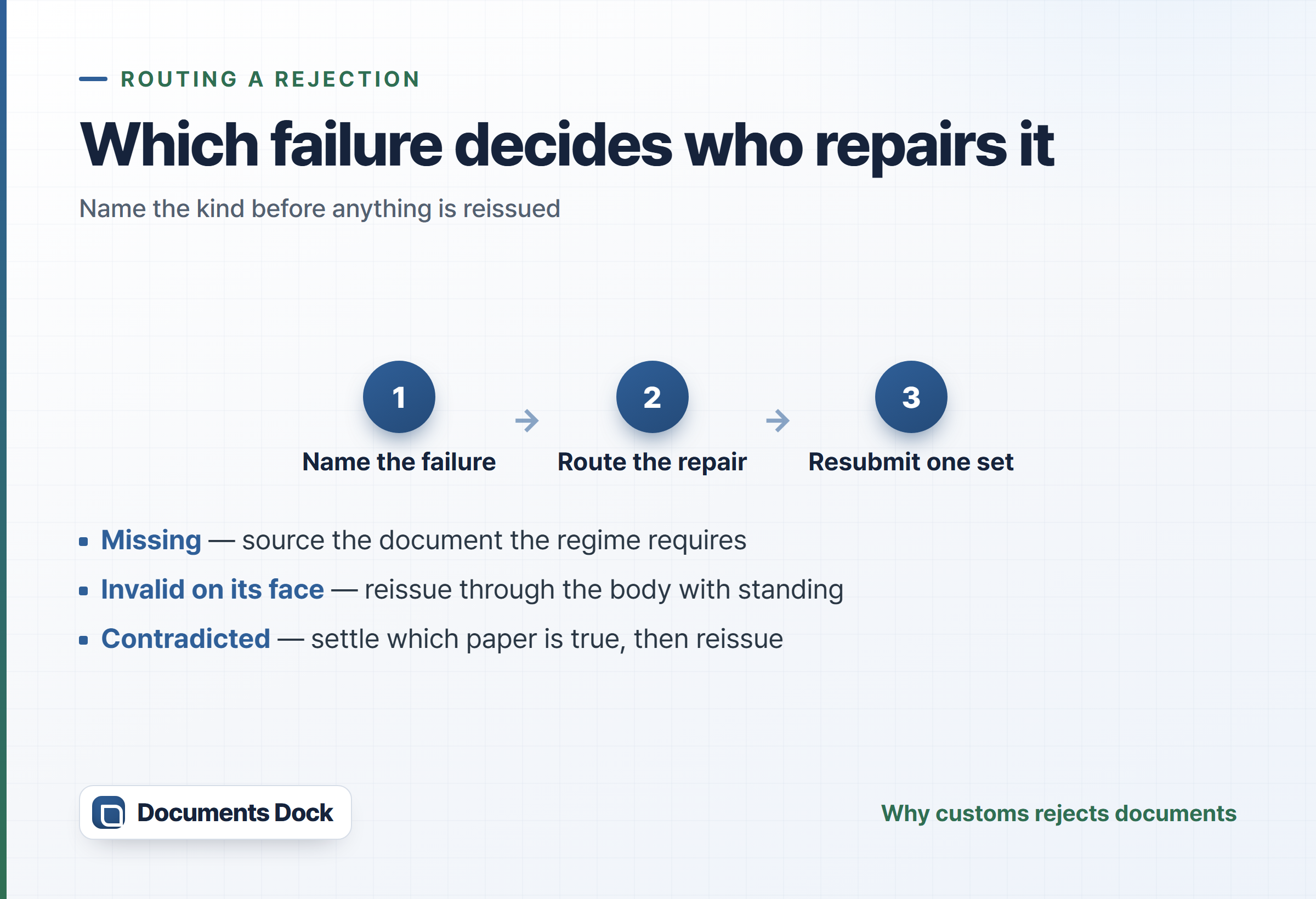
Sorting a rejection into one of the three tells you who fixes it. A missing document is sourced. An invalid one is reissued by whoever had the standing to issue it — standing being the authority the receiving country recognises in a signature or seal. A contradiction has to be settled first: which paper is true?
- **Missing** — a document the regime requires never entered the set: a licence or permit for controlled goods, origin evidence for a preference claim, an inspection or health certificate the destination requires. Nothing is wrong with the papers you sent; the set is short, usually because nobody knew to ask.
- **Invalid on its face** — a document is present but cannot be relied on: unsigned or unsealed where the recipient requires it, outside its validity window, on the wrong form, or issued by a body with no standing. It fails without reference to any other paper.
- **Contradicted** — every document is present and individually sound, but two of them disagree on a field. Each page passes when read alone, which is what makes this kind hard to catch before lodging.
Two things sit outside this list
A declaration can be wrong in itself — classification, valuation method, procedure or relief codes — while every document behind it is sound. And a set can agree with itself and not with what is found in the container. Both are worked by the declarant and the customs broker, not by reissuing a page.
Which fields fail because two documents disagree?
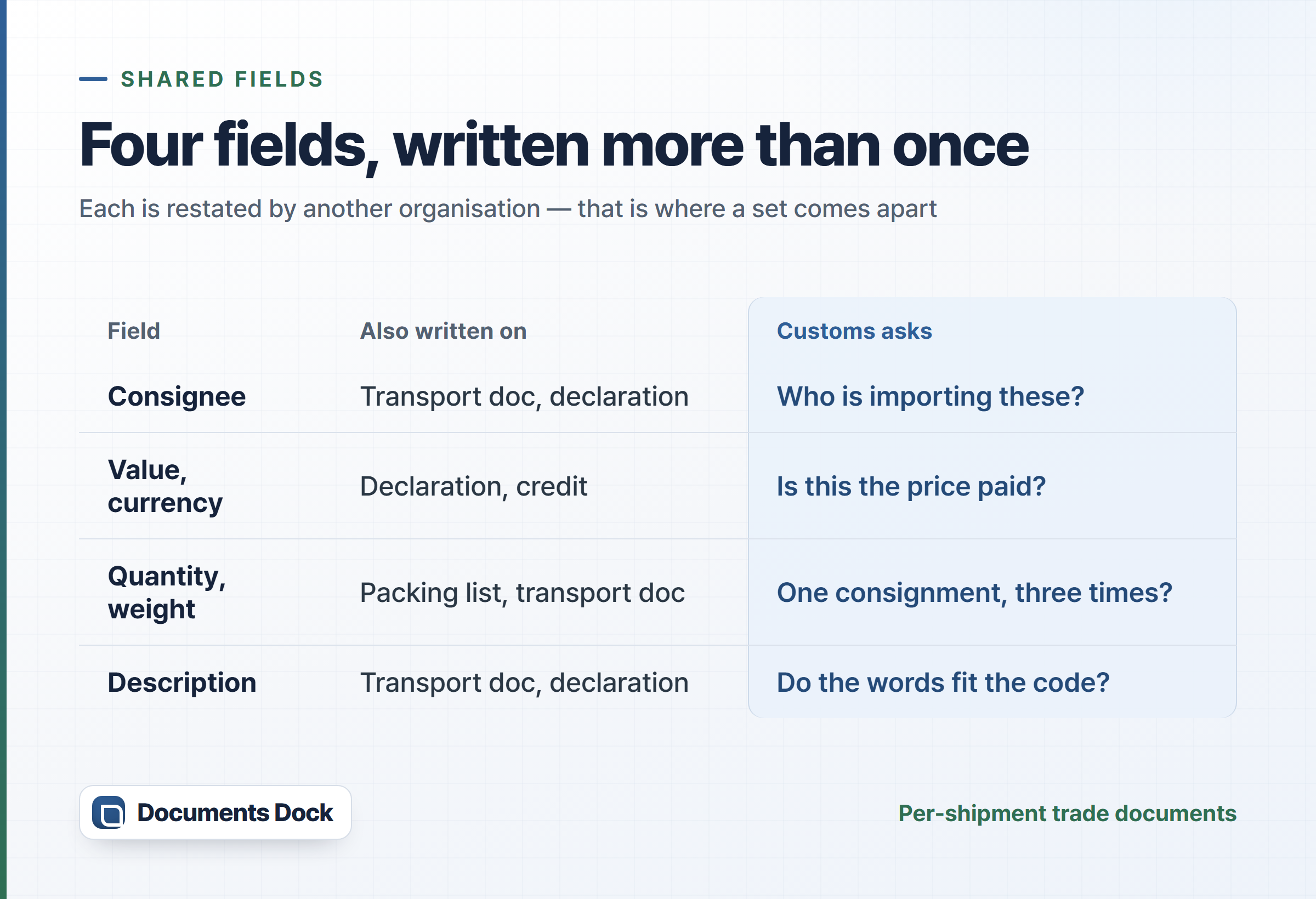
Four fields fail by disagreement: the consignee and parties, the declared value and currency, the quantity, packages and weight, and the goods description. Each is written on at least two documents, by at least two organisations. The field-by-field treatment is in the commercial invoice mistakes that get shipments held; what matters here is the question customs asks on each. Which of the two papers you correct depends on who reads it for what — commercial invoice vs packing list.
- **1. Consignee, buyer and importer of record** — on the invoice, on the transport document (issued by the carrier, or by the forwarder or NVOCC on a house bill), and on the declaration. The importer of record — answerable for the declaration and the duty — is not always the party the goods ship to. *Customs asks: who is importing these goods, and is that party entitled to declare them?* Where a bill of lading is consigned "to order", release runs on the endorsed original — see telex release vs original bill of lading.
- **2. Declared value, currency and what the price includes** — customs valuation normally starts from the transaction value, the price actually paid or payable, with defined additions and deductions, so the invoice total is not automatically the customs value. The agreed Incoterms rule decides how much of the journey already sits inside that price (who pays for shipping and insurance). *Customs asks: is this the price actually paid, and does it include what the rule says?*
- **3. Quantity, packages and weight** — carriers normally reserve the particulars you supply — *said to contain*, *shipper's load and count* — so the transport document repeats your figures rather than verifying them, and a wrong packing list produces a bill of lading wrong in the same way (how to write a packing list). *Customs asks: is this one consignment, described three times?*
- **4. Goods description and the code it supports** — the description has to be specific enough to classify (how to write a commercial invoice). Classification runs on the Harmonized System: its first six digits are common to every country applying it, the digits beyond six are national extensions, and the System is revised periodically. Classification also decides the rest of the set, because whether a licence or inspection certificate is required usually follows from the code. *Customs asks: do the words on the invoice support the code declared?*
Which fields fail on a single document's face?
Four more fail against a standard, a validity window or a version — not against another page. A mismatch hunt runs straight past all of them, which is why they survive as far as lodging.
- **5. Origin — the claim and the evidence for it** — origin evidence comes in two kinds that are not interchangeable. A preferential claim, made to obtain a reduced rate under a trade agreement, must be supported by what that agreement specifies: an official certificate, a declaration by an approved or registered exporter (a status the exporting country grants), or self-certification by the exporter, producer or importer where the agreement permits it. A non-preferential certificate states origin for general purposes, is typically certified by a chamber of commerce or another body the exporting country designates, and carries no preference claim — offered against one, it will be refused.
- **6. Signature, seal and the body that issued it** — some documents become evidence only once someone the receiving country recognises has signed or sealed them, and that requirement belongs to the recipient, not to you. Non-preferential certificates are usually certified by a designated body; preferential evidence follows its agreement, which may name an authority or accept the exporter's own declaration. On some lanes the invoice itself must be attested or legalised before entry — invoice attestation: when you need it, and who stamps it. A scan where an original is required fails on its face.
- **7. Dates and validity windows** — a certificate evidencing a pre-shipment condition, such as inspection or fumigation, cannot be dated after the goods left. Invoices are the opposite case: a final commercial invoice routinely post-dates the transport document once loading confirms quantity and weight, and that is normal. Never re-date a document to tidy a sequence. For licences, permits and health certificates, confirm which date the authority reads validity against — issue, shipment, acceptance of the declaration, or arrival. It varies by document and by destination.
- **8. Reference numbers — the thread through the set** — the invoice number is quoted on the packing list, the certificate of origin, the declaration and often the transport document. Reissue an invoice as INV-2411-A after a price correction and every document still quoting INV-2411 points at a version that no longer exists. A certificate is read against the invoice it names, so consignee, number and description are expected to line up; where the invoice comes from a third party in another country, many agreements require the certificate to flag it.

The requirement is the recipient's, not yours
Whether a signature, a seal, an attestation or a particular form is needed is set by the authority receiving the document, and it varies by destination and by goods. A form that has cleared one market for years can be refused on its face in the next one.
Rejected, queried or held — is there a difference?
The words vary by country and by whoever relays the message. A query asks you for something and clearance waits. A hold stops the goods while an authority verifies a point — often not customs but a health, agriculture or standards body, which is why customs being satisfied does not always release the container. A rejection refuses the document or declaration as filed.
Whatever it is called, it asks for one of three things, and they are the three failures again: another document (the set was short), a corrected document (one could not stand alone), or an explanation (two disagreed). An explanation may need no new paper, but it does need a stated basis. A partial shipment or an agreed discount is normally explained from the paperwork you already hold. Related-party pricing and free-of-charge goods are not: a related-party price is accepted once the authority is satisfied the relationship did not influence it, and goods supplied free of charge have no price paid or payable at all. Both are questions for a licensed customs broker.
How do you stop the same rejection coming back?
Repeat rejections stop when the set is read twice before lodging: each certificate alone, then all of them against one another. Only a solo read finds a certificate that is fine in every respect except the one that matters.
- Read each certificate on its own first — signature and seal, the issuing body, the validity window, and the invoice number it quotes.
- When something is reissued, correct it at the party that issued it and follow every reference to it. Who issues each document, and therefore who can reissue it, is mapped in the full export document set, in order.
- Keep the issued copies with the shipment they belong to, so the version someone asks about later is the version you can produce.
Documents Dock keeps received documents and issued copies side by side per shipment, so the invoice a certificate quotes is the one you can still produce — documentsdock.com.
Sources and scope
This page is general orientation, not customs or compliance advice. Which documents your goods require, which body has standing to certify them, and what a particular authority treats as a defect are set by the destination and change without notice. Confirm the set with a licensed customs broker or the relevant customs authority before you lodge it.
- World Customs Organization (WCO) — Harmonized System, nomenclature and classification (wcoomd.org)
- World Trade Organization (WTO) — Agreement on Implementation of Article VII of GATT 1994, customs valuation (wto.org)
- International Chamber of Commerce (ICC) — Incoterms® 2020 rules (iccwbo.org)
- ICC World Chambers Federation — Certificates of origin (iccwbo.org)
- U.S. International Trade Administration, trade.gov — Common Export Documents (trade.gov/common-export-documents)